
Is GGPoker Ocean Rewards Worth It? Post-Launch Effective Rakeback Breakdown
In TBP’s latest guide to GGPoker’s Ocean Rewards loyalty program, we take a close look at what has changed since its launch, explain how the final cashback and rewards mechanics operate, and analyze what the system really looks like in practice for poker players.
What changed after launch?
On January 30, 2026, GGPoker rolled out Ocean Rewards, officially replacing Fish Buffet as its main loyalty program. The launch finally clarified how GEMs work within the new system, answering one of the biggest questions players had following the announcement.
This article builds on our earlier pre-launch Ocean Rewards analysis, where we examined the announced tier structure and potential implications before the system went live.
What GGPoker didn’t clarify, however, was whether the Player Value Index (PVI) is still in play or not, leaving most players to assume that it remains in place.
So what do these changes actually mean in practice? Let’s break down how Ocean Rewards works mechanically and take a real-world look at early player experiences, especially with regard to how PVI may be influencing their results.
The final mechanics of Ocean Rewards
1. Tide Points and GEMs
Ocean Rewards, GGPoker’s tier-based loyalty system, is built around two parallel currencies: Tide Points and GEMs. While both are earned simultaneously through rake generation, they serve different functions within the ecosystem: Tide Points determine tier progression, while GEMs represent the actual reward currency.
Tier progression is driven exclusively by Tide Points. GGPoker has stated a base accrual rate of 100 Tide Points per $1 in rake generated. These points accumulate over time and unlock one of eight loyalty tiers. The Tide Point thresholds required for each tier are outlined in Table 1. In practical terms, Tide Points function purely as a progression metric and have no direct redemption value.
GEMs, on the other hand, are awarded at the same base rate of 100 GEMs per $1 in rake, but unlike Tide Points, GEM earnings are tier-dependent. Each tier applies a specific multiplier to GEM accrual, meaning your effective rebate rate scales with your loyalty status.
For example, at the Shrimp tier, a 2x GEM multiplier applies. This means generating $1 in rake (100 Tide Points) results in 200 GEMs instead of the base 100. Higher tiers further increase this multiplier, directly improving long-term reward efficiency. The complete structure of tier thresholds and GEM multipliers is provided in Table 1.
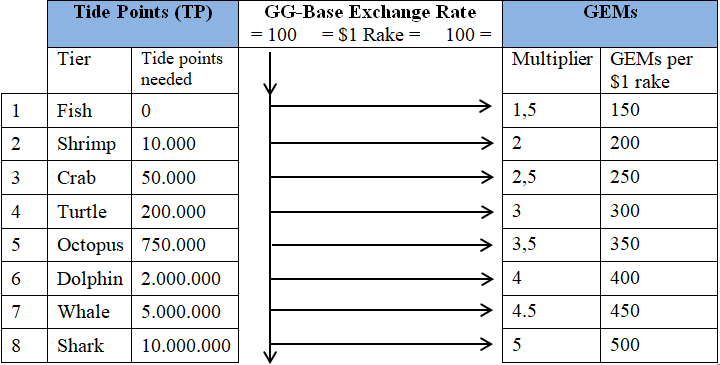
Table 1: Complete structure of tiers and GEMs
To summarize this paragraph in short:
- Tide Points determine how high you climb on the tier ladder
- The higher you climb, the more GEMs you earn
2. Rewards and cashback
However, within the Ocean Rewards loyalty system, it is important to distinguish between earning rewards and realizing cashback (which, in this context, is equivalent to rakeback). Players do not receive instant or automatic cashback simply by generating rake through Ocean Rewards. Instead, rake generation yields GEMs, which function as the internal reward currency of the system. Cashback is only realized when these GEMs are redeemed for cash-equivalent rewards. The value of a player’s rewards therefore depends not only on their tier and GEM multiplier, but also on the redemption rates available in the rewards shop. Table 2 presents the fourteen cash-equivalent redemption values for GEMs and illustrates how the effective value per GEM increases at higher redemption tiers.
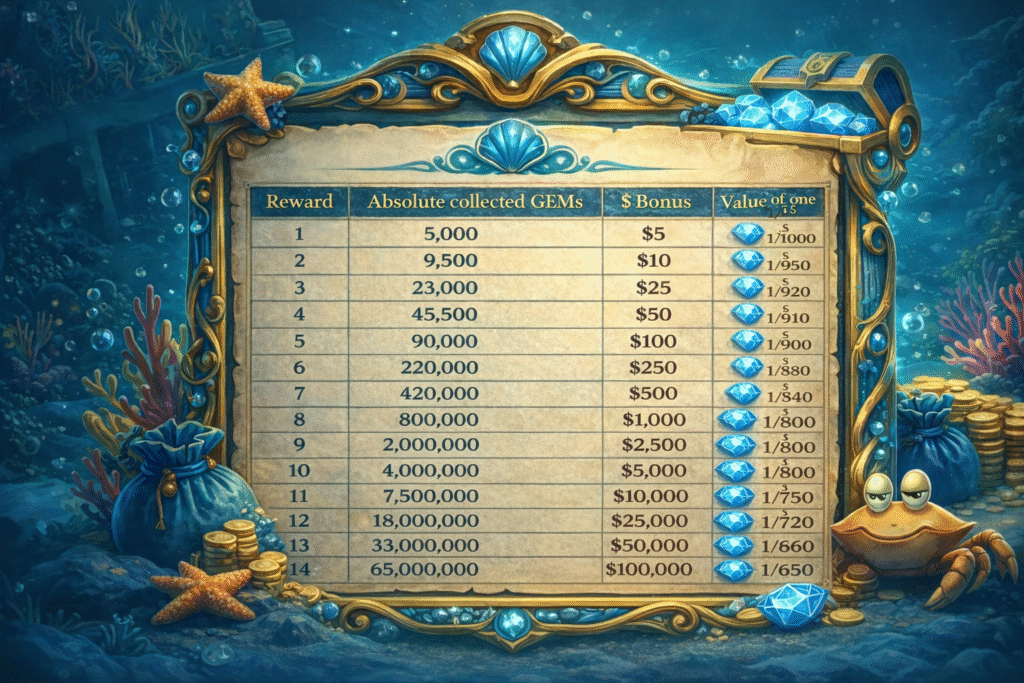
Table 2: GEMs cash value
At this point, it is necessary to consider a less transparent element of the Ocean Rewards loyalty system that may not be immediately apparent to most players but has meaningful implications for their realized rewards: the opportunity cost of holding GEMs, as shown in Table 3.

Table 3: Opportunity cost of GEMs
As higher redemption tiers improve the cash-equivalent value per GEM, players should also consider the opportunity cost of delaying redemption. Holding GEMs instead of redeeming them immediately effectively ties up value within the loyalty system. During this period, players forgo the ability to deploy those funds elsewhere, whether for bankroll use, investment, or other financial purposes.
Additionally, delayed redemption exposes players to potential rule changes or adjustments redemption rates. Therefore, the decision to accumulate GEMs for more favorable exchange rates is not purely mechanical; it also represents an intertemporal trade-off between higher nominal efficiency and liquidity.
Next, it is important for players to understand that the advertised cashback is not a separate or automatic payment. Instead, it represents the theoretical rakeback a player can achieve if GEMs are redeemed at the best available cash-equivalent rates for their tier. In other words, cashback under Ocean Rewards is realized indirectly through GEM redemptions, not through direct rakeback credits.
There is one final nuance that often confuses players: where do the advertised cashback percentages actually come from, given that there is no direct cash transfer? The mechanics behind the cashback figure displayed in Table 4 are not immediately transparent, which is why they will be clarified in the next section.
To summarize this paragraph briefly:
- GEMs represent the monetary reward currency within the loyalty system
- Players should consider the opportunity cost of holding GEMs instead of redeeming them
- Cashback is not an automatic payment and can only be realized through GEM redemption
- Advertised cashback does not necessarily equal realized cashback.
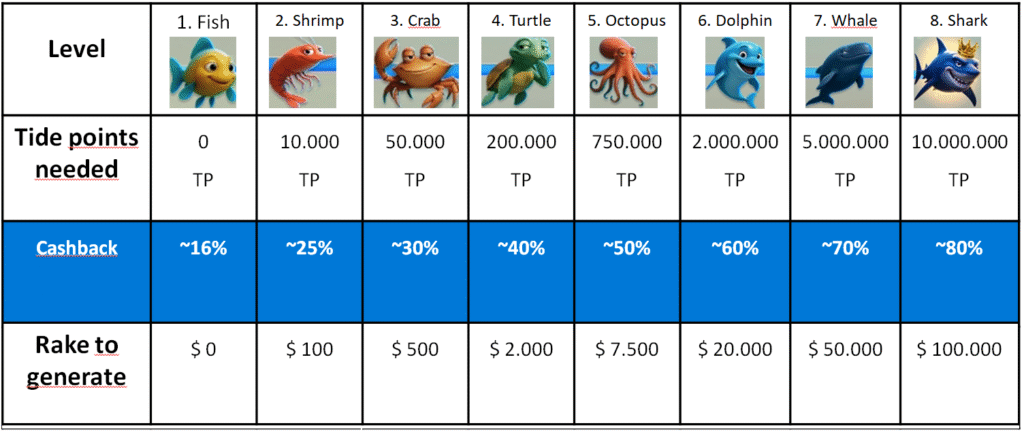
Table 4: Ocean Rewards advertised figures
3. How “advertised cashback” is derived (step-by-step example)
To clarify how the headline cashback figures are derived and why realized cashback may differ from those numbers, let’s walk through a simplified example.
a. Earning Tide Points and GEMs:
Based on GGPoker’s stated rates, for every $1 in rake generated a player earns 100 Tide Points (TP) and 100 GEMs. If we assume our model player is currently in the Shrimp tier, which applies a 2x GEM multiplier (see Table 1), the player’s effective GEM earnings per $1 in rake increase accordingly. In this case, the player earns 200 GEMs per $1 in rake (2 x 100 GEMs).
b. Convert GEMs to cash:
To convert GEMs into cash-equivalent value, we need to establish the monetary value of a single GEM. GGPoker states that 5,000 GEMs can be redeemed for $5, which implies an exchange rate of 1,000 GEMs = $1 using the baseline cash-equivalent redemption rate available in the rewards shop. This yields a per-GEM value of:
1 GEM = $0.001 (see Table 2)
From the previous step, our model player earned 200 GEMs for $1 in rake at the Shrimp tier. Converting this to cash-equivalent value:
200 GEMs × $0.001 = $0.20
In this simplified example, the player therefore realizes $0.20 in rewards for every $1 in rake generated, before expressing this value as an effective cashback percentage in the final step.
c. Expressing this as cashback:
In this example, the model player generated $1 in rake and realized $0.20 in cash-equivalent value through GEM redemptions, which corresponds to an effective cashback rate of 20%. This is below the advertised 25% cashback associated with the Shrimp tier. So where does the difference come from?
d. Advertised vs. realized cashback
The advertised cashback figures assume either:
- Higher average GEM multipliers,
- More favourable redemption rates,
- or a combination of both.
For example, if a player has a tier multiplier of 2.5×, they would earn 250 GEMs per $1 in rake, at a base redemption value of $0.001 per GEM, this corresponds to an effective cashback rate of 25%.
The same 25% effective cashback can also be achieved with a lower tier multiplier if the redemption value per GEM is higher. For instance, a redemption rate of $0.00125 per GEM, as implied by a rewards shop offer of 800,000 GEMs for $1,000, would yield the same effective return even with fewer GEMs earned per dollar of rake.
To summarize this paragraph in short:
The advertised cashback percentages under Ocean Rewards are not guaranteed outcomes. They are derived from assumptions regarding tier stability, GEM multipliers, and optimal redemption behavior. In practice, a player’s realized cashback will vary depending on:
- Volume consistency,
- Tier progression and maintenance,
- GEM redemption efficiency.
The example above was intended to illustrate the theoretical mechanics behind the Ocean Rewards loyalty system based on the publicly available information released by GGPoker. It demonstrates that Ocean Rewards operates as a variable rebate system rather than a flat cashback model.
Ocean Rewards key formula
All of the above was intended to illustrate the theoretical mechanics behind the Ocean Rewards loyalty system based on the information publicly released by GGPoker. As we saw in practice, a player’s realized cashback will vary depending on volume, tier stability, and redemption efficiency.
In the following section, we translate this information into a simple and practical formula that immediately shows a player their effective cashback and interprets it.
Ocean Rewards effective cashback formula
Effective cashback in poker refers to the actual percentage of rake a player receives back in rewards. Within the Ocean Rewards loyalty program, effective cashback (Eff. CB) can be derived using the following equation, as demonstrated in the step-by-step example (see Section 3):
Eff. CB % = (GEMs earned per $1 in rake) × (cash-equivalent value per GEM)
More formally:
Eff. CB % = (GEMs per $) × ($ per GEM) / 1
To simplify:
- “GEMs per $” already expresses a unit rate (GEMs per $1 of rake)
- “$ per GEM” expresses the monetary value of one GEM
Multiplying these two terms: GEMs/$ x $/GEM = $/
The units cancel out, directly yielding the return per dollar of rake paid. Because the rate is already calculated per $1 of rake, no further adjustment is required. Therefore, the simplified effective cashback formula is:
Eff. CB % = (GEMs per $) × ($ per GEM)
Interpretation of the formula
According to this equation, a player’s effective cashback percentage increases when:
- GEMs earned per $1 in rake increases
This term reflects how many loyalty points (GEMs) a player earns for each dollar of rake paid.
As shown in Table 1, higher tiers provide higher GEM multipliers.
Reaching and maintaining higher tiers requires sustained playing volume.
- Cash-equivalent value per GEM increases ($ per GEM)
This term reflects how valuable each GEM is upon redemption.
As shown in Table 3, larger GEM balances may unlock more favorable redemption rates.
Achieving this typically requires either a high playing volume, or delayed redemption ( accumulating GEMs over time).
Taken together, the formula shows that Ocean Rewards structurally favors players who generate high and consistent volume. Also, the equation is in line with the two factors derived in the example (see Sec. 3).
Who benefits from the mechanics?
From a poker player’s perspective, the key optimization dynamic of Ocean Rewards is already evident from the information presented thus far and can be summarized as a simple feedback loop connecting volume, tier progression, and effective rewards as shown in Table 5.
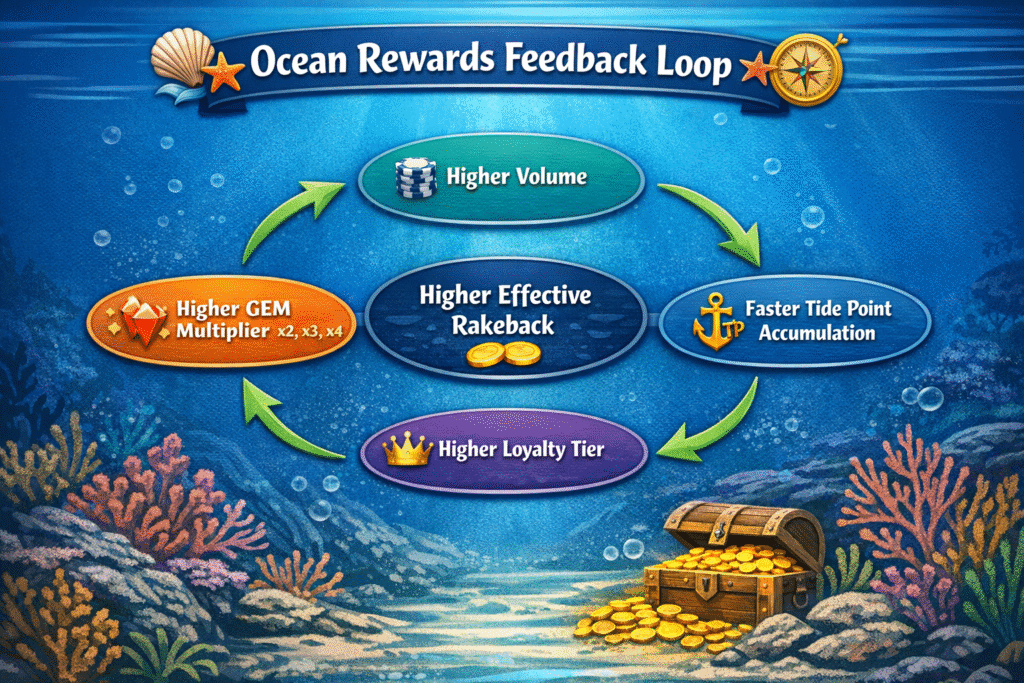
Table 5: Feedback loop
The logic behind this feedback loop is straightforward and can also be expressed through the following causal chain of effects, as shown in Table 6.
| Higher volume → faster Tide Point accumulation → higher tier → higher GEM multiplier → !!!higher effective cashback per dollar raked!!! |
TABLE6: Causal chain of effects
As a result, Ocean Rewards disproportionately benefits players who can sustain high volume and consistently climb or maintain higher tiers. Low-volume and recreational players, by contrast, are structurally capped at lower tiers and therefore realize lower effective returns on their rake.
A real-life field trip to PVI
Early feedback from players at GGPoker suggests that the effective collection rate for Tide Points and GEMs can differ materially from the stated base rate of 100 Tide Points / 100 GEMs per $1 in rake. Several players report receiving significantly fewer points per dollar of rake generated. From the mechanics outlined above, it follows directly that lower collection rates mechanically translate into lower effective cashback.
While GGPoker has not publicly confirmed whether the Player Value Index (PVI) remains in effect under Ocean Rewards, a plausible explanation for these observed discrepancies is the continued application of a player-specific adjustment mechanism similar to PVI. This interpretation is further supported by GGPoker’s own disclaimer that “the collection rates for Tide Points and GEMs in each tier may change at GGPoker’s discretion, with or without prior notice.”
The concept of PVI and its economic implications were discussed in the previous mentioned article, pre-launch Ocean Rewards analysis. The central takeaway was that the PVI can be modeled conceptually as a multiplicative adjustment factor applied to both Tide Point and GEM accrual. Under this interpretation, the effective reward-generation process can be expressed as:
Eff. CB % = (Base GEMs per $) × ($ per GEM) × PVI
If PVI is assumed to be strictly bounded between zero and one (0 < PVI < 1), such an adjustment has clear financial consequences for affected players. It reduces both their immediate reward flow (via GEMs) and their long-run tier progression (via Tide Points). As a result, PVI impacts Ocean Rewards outcomes through two distinct channels:
- Reduced effective cashback due to lower GEM accrual per dollar of rake.
- A dampening of the positive feedback loop between volume, tier progression, and reward efficiency.
Under a PVI regime with 0 < PVI < 1, players experience not only lower cashback in the short run but also slower tier progression over time. This weakens the self-reinforcing mechanism by which higher volume leads to higher tiers and, in turn, to more favorable reward rates. In this sense, PVI functions not merely as a “tax on rakeback” within the Ocean Rewards system but as a modifier of reward mobility: it pushes affected players onto a persistently lower reward trajectory by slowing their progression into tiers with superior earn rates.
Crucially, the effect of PVI is intertemporal. It does not only ensure that affected players earn less today; it also ensures that they earn less tomorrow, because their reward rate itself improves more slowly over time.
That said, the precise mechanics of how GGPoker currently applies any player-specific adjustments remain unconfirmed. If any such adjustment were applied solely to GEM accrual and not to Tide Point generation, the second channel described above (the dampening of the positive feedback loop via slower tier progression) would be substantially weakened or potentially be absent. In that case, the primary effect of PVI-like mechanisms would be confined to immediate cashback rather than long-run reward mobility.
It is important to emphasize that the discussion of PVI or similar adjustment mechanisms presented here is purely hypothetical. The internal mechanics of GGPoker’s system are not publicly disclosed. However, the model outlined above allows readers to explore how different assumptions about such adjustment factors would affect effective cashback and long-run tier dynamics.
The final word
Ocean Rewards is not a traditional cashback system. It is a progression engine.
At first glance, the advertised cashback percentages suggest a straightforward tier-based rebate program. But once the mechanics are unpacked, a different reality emerges. Effective cashback under Ocean Rewards is not guaranteed, not fixed, and not automatic. It is a derived outcome which depends on volume, tier stability, redemption efficiency, and potentially player-specific adjustments.
The system is built around a reinforcing feedback loop:
Higher volume → faster tier progression → higher GEM multipliers → better redemption efficiency → higher effective cashback.
For players who can sustain high and consistent volume, this structure compounds in their favor. For low-volume or recreational players, the opposite is true. Slower progression means weaker multipliers, weaker redemption rates, and structurally lower realized returns. The headline cashback percentages therefore function less as promises and more as theoretical upper bounds achievable under optimal conditions.
If no player-specific adjustment mechanism exists, Ocean Rewards operates primarily as a volume ladder: grind more, earn more. But if a mechanism similar to PVI remains in effect, the system transforms into something else entirely, like a selective reward allocation model. In that case, reward efficiency is not only a function of volume, but also of how the platform internally classifies a player’s value.
This distinction matters.
Without PVI, Ocean Rewards rewards consistency.
With PVI, it rewards selectivity.
In both cases, the key metric for players is not the advertised cashback percentage, but effective cashback, which is the actual dollars returned per dollar paid in rake, calculated from real GEM accrual and real redemption value.
Ocean Rewards may indeed represent an evolution in loyalty design. But it is not simple, and it is not neutral. It shifts poker loyalty away from transparent rakeback toward a conditional, progression-based incentive structure with embedded asymmetries.
For players evaluating its true economic impact, one principle stands above all:
Ignore the headline percentages and track your effective cashback.
We’ll continue monitoring Ocean Rewards as more real-world data emerges. If you want to discuss how these mechanics affect your specific format, limits, or long-term ROI, join the conversation inside our Discord community.